

The Great Silk Road occupied a special place in the development of human civilization, connecting the East and the West not only in terms of trade, but also through the exchange of cultures, science, and spiritual values. For thousands of years, this route served as an important economic and geopolitical factor that shaped the course of world history. The main nodes of the Great Silk Road passed through the territory of present-day Turkmenistan, confirming the country’s historical role as a center of international relations since ancient times.
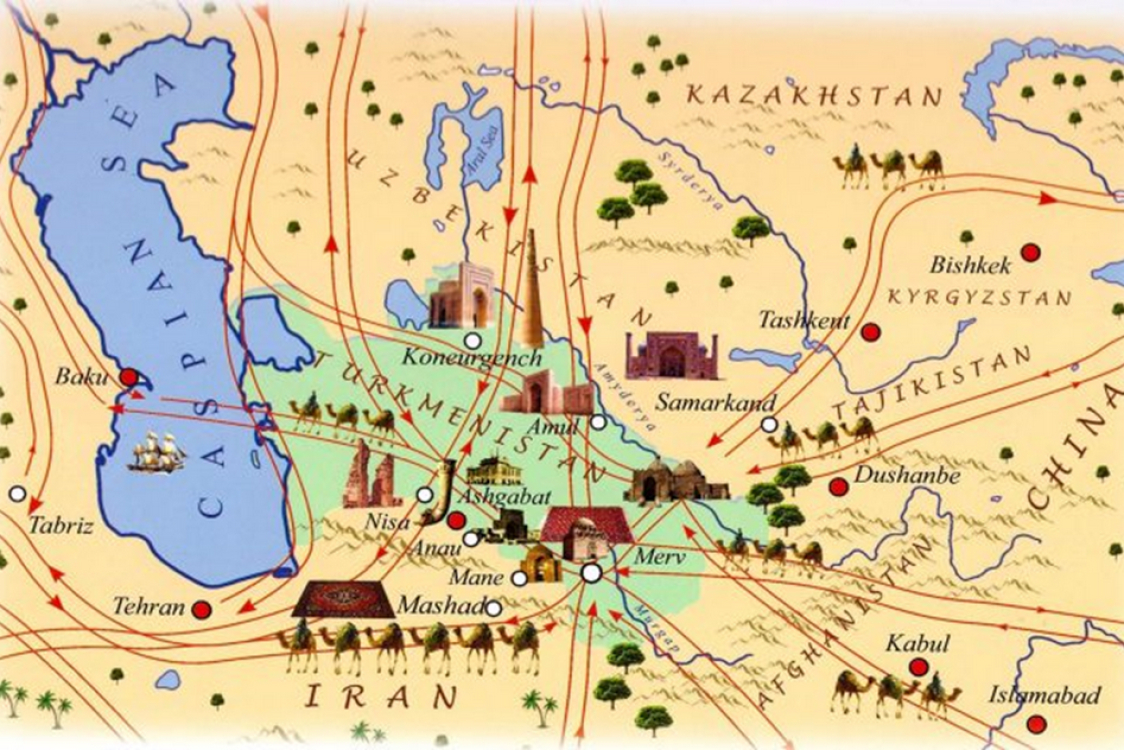
The emergence of the Great Silk Road dates back to the 2nd century BCE and encompassed a multifunctional network of routes stretching from China through Central Asia to the Middle East and Europe. It was not a single road, but an extensive system of interconnected trade and communication routes. Through this network, silk, precious stones, metals, aromatic substances, textiles, as well as scientific and cultural achievements were transported from one region to another.
Within the territory of Turkmenistan, ancient cities such as Merv, Nisa, Amul (modern Turkmenabat), and Koneurgench served as major hubs of the Great Silk Road. These cities functioned not only as centers of trade, but also as important centers of science, culture, and craftsmanship. Through them, economic and cultural ties between the East and the West were strengthened.
The significance of the Great Silk Road was not limited to trade relations alone. It contributed to the development of dialogue among different civilizations and fostered mutual understanding and cooperation among peoples. The spread of religious teachings, scientific ideas, and architectural styles was also carried out through this route. Thus, the Great Silk Road stands as a historical example of integration and cooperation in world history.
The book ‘Turkmenistan — Heart of the Great Silk Road’ by the National Leader of the Turkmen people, Chairman of the Halk Maslahaty of Turkmenistan Gurbanguly Berdimuhamedov, demonstrates how this historical heritage continues to evolve with renewed meaning in the modern era. The work provides an in-depth analysis of Turkmenistan’s historical role along the Great Silk Road, the development of ancient cities, archaeological discoveries, and the country’s strategic position at the crossroads of civilizations. The book emphasizes that the Great Silk Road is not only a legacy of the past, but also a contemporary foundation for economic development and international cooperation.
Located at a strategic crossroads of Eurasia, Turkmenistan is consistently strengthening its status as one of the key transit and transport hubs of the region. In modern conditions, the idea of reviving the Great Silk Road finds its practical realization through the implementation of large-scale infrastructure projects aimed at forming sustainable and interconnected transport corridors. The country’s advantageous geographical position contributes to the expansion of trade and economic relations, the acceleration of cargo transportation, and the development of multilateral cooperation among the states of Central Asia, the Caucasus, the Middle East, and Europe.
The President of Turkmenistan, Serdar Berdimuhamedov, pursuing a balanced and far-sighted foreign policy in the conditions of the 21st century, consistently puts forward international initiatives aimed at developing a modern transit and transport infrastructure that serves the interests of sustainable and harmonious development of countries worldwide. Particular attention is paid to the practical and timely implementation of these initiatives, reflecting Turkmenistan’s strategic approach to strengthening global cooperation in the transport sector.
Active participation in the implementation of large-scale regional transport projects in cooperation with international organizations occupies an important place in the ‘Concept of the Foreign Policy Course of Neutral Turkmenistan’ and the ‘Program for the Development of Transport Diplomacy of the President of Turkmenistan.’ A clear confirmation of the effectiveness of this policy is the adoption by the United Nations General Assembly, at the initiative of Turkmenistan, of a number of resolutions devoted to the role of transport and transit corridors, the development of multimodal transport, and the strengthening of interconnectivity among all modes of transport in the interests of sustainable development, including in the post-pandemic period, as well as the establishment of World Sustainable Transport Day. These decisions vividly demonstrate Turkmenistan’s high international standing and the country’s significant achievements in the field of transport diplomacy.
International transport and transit corridors involving Turkmenistan occupy a prominent place in this process, including the multimodal route ‘Afghanistan–Turkmenistan–Azerbaijan–Georgia–Turkey,’ the international transport corridor ‘Turkmenistan–Azerbaijan–Georgia–Romania,’ running along the Caspian Sea–Black Sea axis, as well as the multilateral multimodal corridor ‘China–Kyrgyzstan–Uzbekistan–Turkmenistan–Azerbaijan–Georgia–Turkey–Europe.’ These routes contribute to the expansion of transport links between regions and to the strengthening of the country’s transit potential.
Alongside this, transport and transit corridor projects ‘Uzbekistan–Turkmenistan–Iran–Oman’ and ‘Uzbekistan–Turkmenistan–Iran–Turkey,’ as well as the international railway line ‘Kazakhstan–Turkmenistan–Iran,’ are of major strategic importance, as they provide access to the ports of the Persian Gulf and establish reliable connections between Central Asia and global markets. The consistent implementation of these initiatives, together with their international recognition at the United Nations level, clearly attests to the growing role of Turkmenistan in shaping the modern system of international transportation.
From an economic perspective, the growth of international transit potential expands Turkmenistan’s export opportunities, creates new jobs, and promotes economic diversification. Overall, the Great Silk Road is not only part of Turkmenistan’s historical past, but also a key pillar of the country’s modern development strategy. The historical experience of this trade route forms a solid foundation for the creation of a modern transport and logistics system.
Read also

Advertising



 Read us in Zen


