



The latest stage of the Russian-Turkmen Margiana Archaeological Expedition took place in Turkmenistan from September 20 to October 30, 2026. According to the Turkmenportal, the work was carried out under an agreement between the Institute of Ethnology and Anthropology of the Russian Academy of Sciences (IEA RAS) and the Ministry of Culture of Turkmenistan.
Researchers from the IEA RAS and the Institute for the History of Material Culture of the Russian Academy of Sciences (IHMC RAS) took part in excavations at Gonur Depe, a Bronze Age archaeological site. Specialists from Turkmenistan’s Department for the Protection, Study and Restoration of Historical and Cultural Monuments and the Ancient Merv State Historical and Cultural Reserve also joined the expedition. Joint research resumed after a two-year break.
The expedition’s main objective was to study the settlement structure of the ancient country of Margush, or Margiana, which was located in the delta of the Murghab River more than 4,000 years ago. During this stage, the main research programme at the Gonur-20 settlement, located near the central archaeological site, was completed. To determine the purpose of peripheral settlements, archaeologists began a more detailed study of Gonur-27.
Researchers уточнили the boundaries of Gonur-20 and examined ovens, burials and other structures. The finds included bronze and stone seals, fragments of seals, and agricultural tools.
The study of ceramic assemblages from the Gonur oasis also continued. The materials obtained will help clarify the development of local cultures in the late third and second millennia BC and trace historical processes in this part of Eurasia.
Excavations at Gonur Depe have been underway for more than 50 years. It is the largest known settlement of ancient Margiana, which existed in the late third and early second millennia BC. The Margiana civilization was discovered in the 1970s by Soviet and Russian archaeologist Viktor Sarianidi. This discovery became one of the notable achievements of 20th-century archaeology. The scholar’s work is being continued by his students.
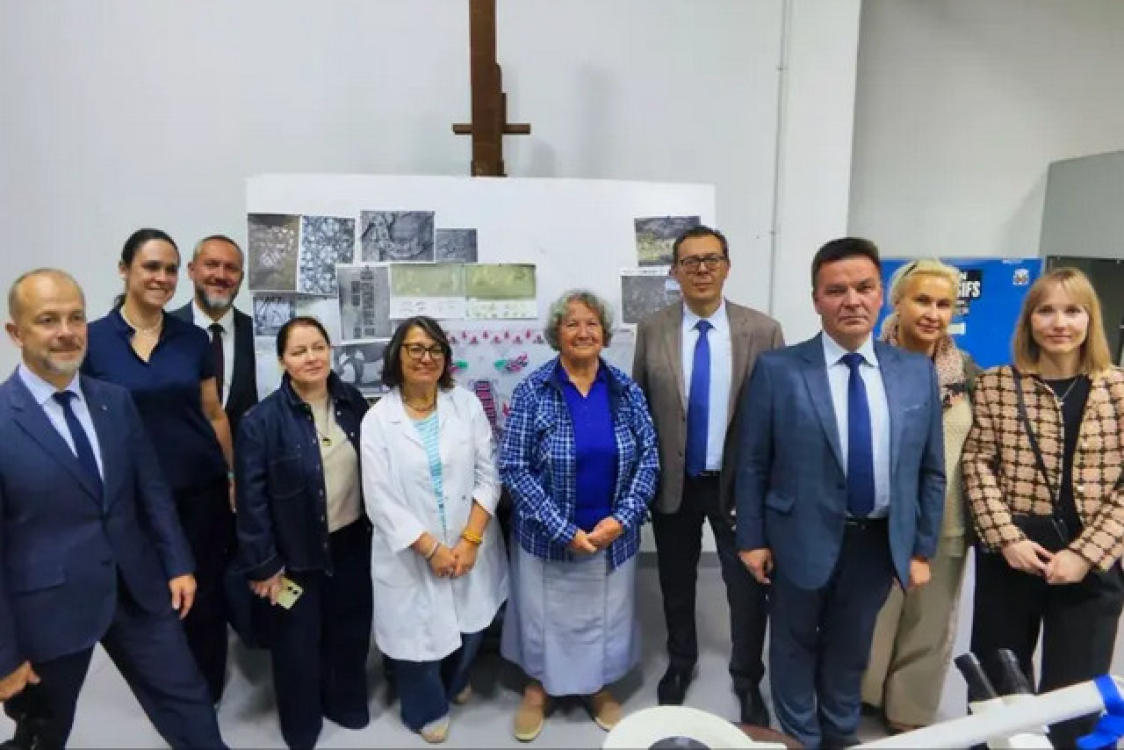
On October 28, staff of the Russian Embassy met in Ashgabat with the expedition leader, Doctor of Historical Sciences Nadezhda Dubova, and Galina Veresotskaya, a restoration artist at the State Research Institute for Restoration of the Russian Ministry of Culture.
Participants discussed the results of the work carried out over the previous month. Nadezhda Dubova led field research in Mary Velayat with the participation of specialists from the IHMC RAS. Galina Veresotskaya worked at the restoration laboratory of the Turkmenistan Museum of Fine Arts in Ashgabat.
The Russian researchers thanked their Turkmen colleagues for their cooperation and support. Both sides expressed readiness to continue field research in spring 2027.
The next stage will involve studying finds collected during years of excavations in Margiana and held in museums across Turkmenistan.
Read also


Advertising




 Read us in Zen


