



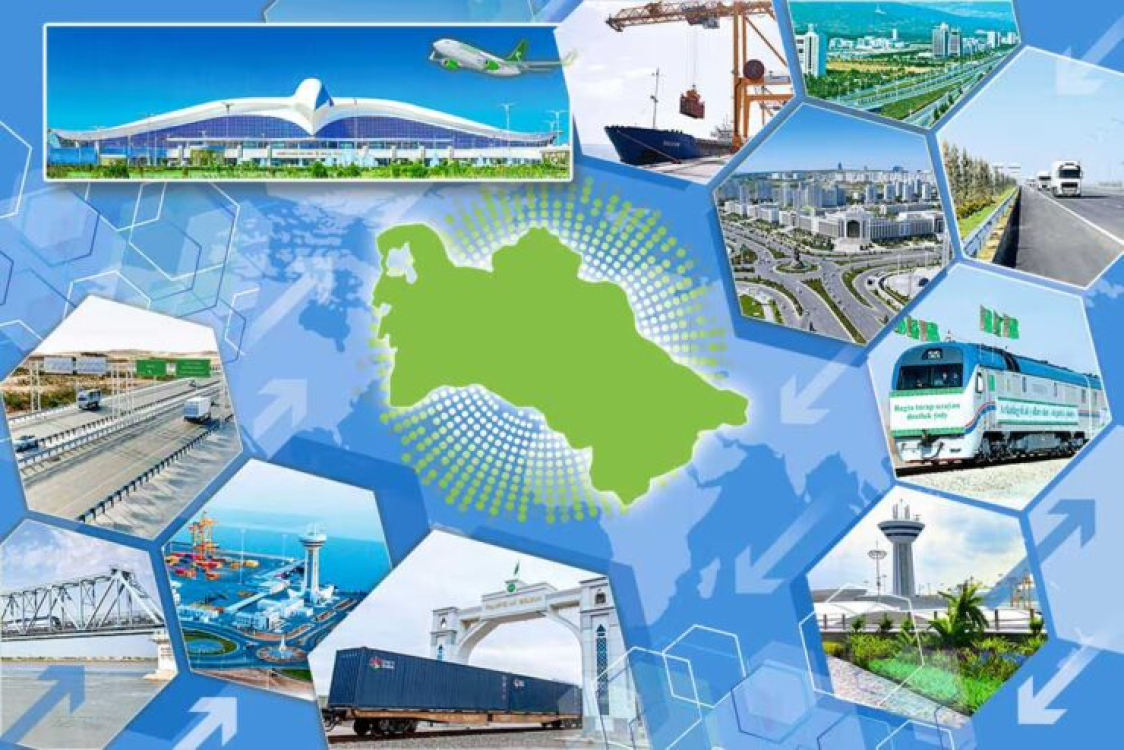
The year 2025, declared by the UN General Assembly as the International Year of Peace and Trust, has become a stage of large-scale modernisation of the transport and communication system for Turkmenistan. Infrastructure projects being implemented in the country are aimed at transforming the state into one of the leading transit hubs in Eurasia, according to the state news agency TDH.
The national transport strategy is based on the idea of reviving the Great Silk Road, which is now being filled with modern content. Under the leadership of Turkmenistan's President Serdar Berdimuhamedov, programmes to develop rail, road, air, sea and digital communications are being consistently implemented in the country.
Turkmenistan participates in key international transport initiatives, including the Ashgabat Agreement, the Lapis Lazuli Corridor, the TRACECA project and the ‘Kazakhstan-Turkmenistan-Iran’ railway. These routes form a ‘North-South’ and ‘East-West’ link, strengthening the region's integration into global logistics.
In December 2025, at the initiative of Turkmenistan, the UN General Assembly adopted a Resolution proclaiming the Decade of Sustainable Transport (2026–2035), which was an international recognition of the country's role in shaping the global transport agenda.
Institutional reforms gave a significant boost to the development of the industry. In 2025, specialised ministries and government agencies were established in the country for rail, road, sea, air transport and communications, which made it possible to improve management efficiency and introduce modern standards.
Civil aviation is actively developing: Balkanabat International Airport has been put into operation, a flight safety programme has been approved, and international cooperation is expanding. The airline ‘Turkmenistan’ has become a member of TIACA, and the country's aviation school has received ICAO international certification.
Maritime infrastructure is being strengthened through the modernisation of ports, the Balkan shipyard and the expansion of Caspian routes. In the field of motorways, new highways are being built, including the ‘Turkmenbashi-Garabogaz’ section and a bridge across the Garabogazkol Bay connecting Turkmenistan with Kazakhstan.
Rail transport is being equipped with modern rolling stock, which is expanding the geography of transit traffic. At the same time, digital infrastructure is being developed: fibre-optic networks are being expanded, e-government is being introduced, and cybersecurity is being strengthened.
The city of Arkadag has become a special symbol of the digital future, with the introduction of 4G+ and 5G technologies, as well as elements of a ‘smart’ and ‘green’ city.
Thus, Turkmenistan is not only reviving the idea of the Great Silk Road, but also forming a modern transport and communication corridor, strengthening its position as a reliable international partner and an important logistics centre in Eurasia.
Read also

Advertising



 Read us in Zen


