



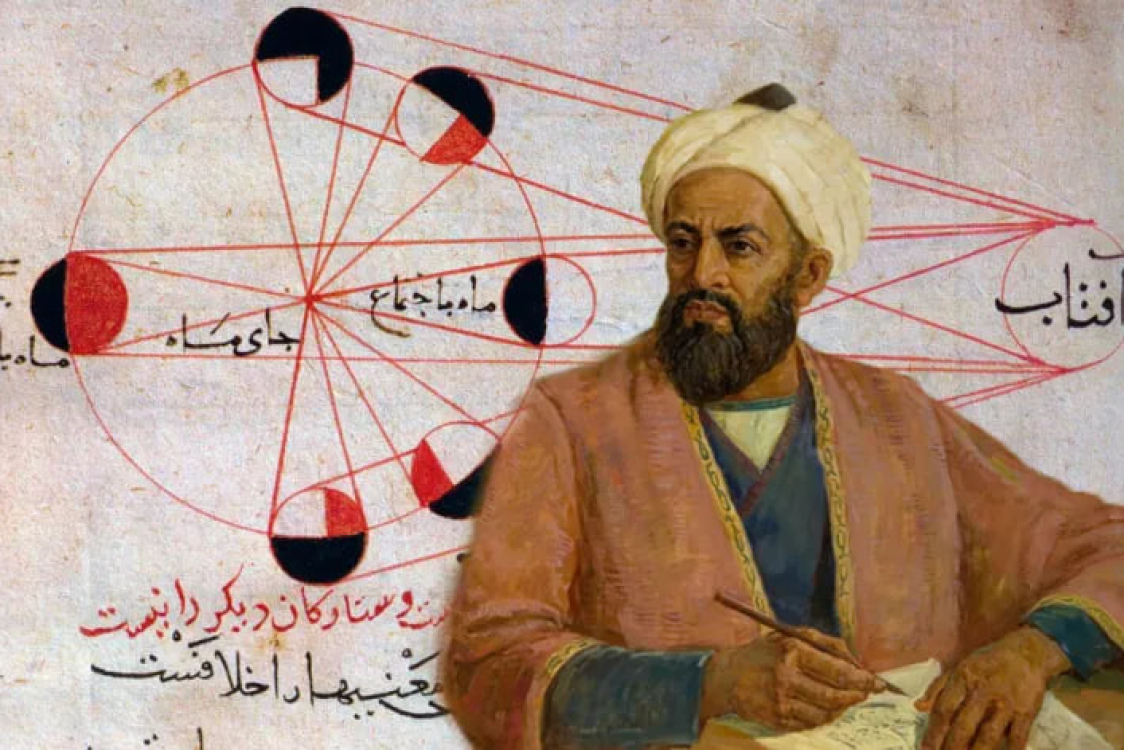
UNESCO has described Abu Rayhan Muhammad ibn Ahmad al-Biruni as a ‘universal genius’ who lived in Central Asia a thousand years ago. The scholar was born on 4 September 973 in the town of Kas in ancient Khwarezm. He studied astronomy, mathematics, geography, history, physics, mineralogy, pharmacology and other sciences. This is reported by Arzuw.news, citing the newspaper ‘Neutral Turkmenistan’.
Al-Biruni’s teacher was the mathematician and astronomer Abu Nasr Mansur ibn Iraq. The scholar is credited with around 180 works, some of which have survived to this day. Among the best known are ‘Chronology of Ancient Nations’, ‘India’, ‘The Canon of Mas’ud’, ‘The Book of Precious Stones’ and ‘Pharmacognosy’.
‘The Canon of Mas’ud’ contains astronomical and mathematical calculations, tables and information on the motion of celestial bodies. Using geometric methods and observations, al-Biruni calculated the radius of the Earth, arriving at a value close to the modern one.
In his work ‘India’, the scholar explored the mathematics, astronomy, philosophy, religion, geography and culture of India. To work with primary sources, he learnt Sanskrit.
Pharmacology occupies a significant place in al-Biruni’s legacy. In ‘Kitab al-Saydana fi al-Tibb’, he systematised information on medicinal substances, plants and minerals, and regarded pharmacy as an independent field of knowledge.
Today, a lunar crater and an asteroid bear al-Biruni’s name. In 1974, UNESCO’s magazine ‘Courier’ dedicated a special issue to the scholar. His scientific legacy continues to be studied by researchers.
Read also



Advertising




 Read us in Zen


