



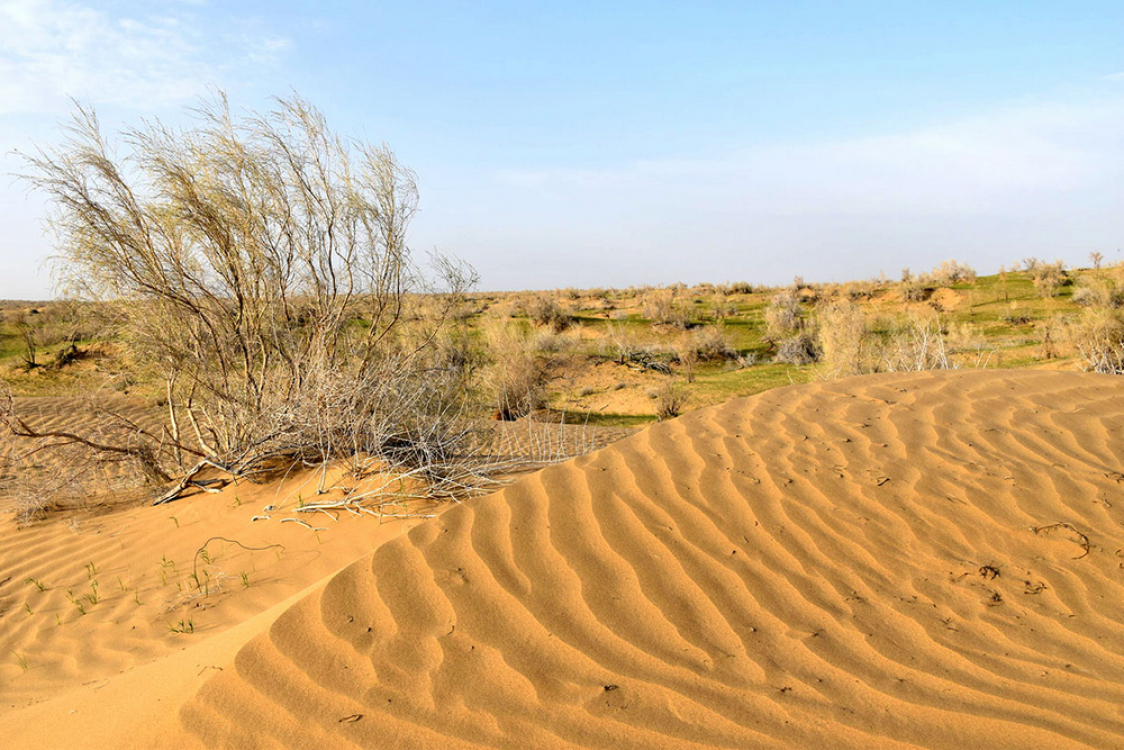
The Regional Centre for Combating Desertification in Ashgabat will enable Central Asian countries to jointly address transboundary issues affecting agriculture and water management. This was stated by Pirli Kepbanov, Director of the National Institute of Deserts, Flora and Fauna of the Ministry of Environmental Protection of Turkmenistan. His words are quoted by the newspaper ‘Neutral Turkmenistan’, reports Turkmenportal.
He recalled that the initiative to create the centre was put forward by the President of Turkmenistan, Serdar Berdimuhamedov, at the 80th session of the UN General Assembly in New York.
According to Pirli Kepbanov, the centre will serve as a platform for coordinating the efforts of countries in the region on issues related to land degradation and water resource management. This, he noted, will allow for the consolidation of the scientific and practical potential of the countries and strengthen regional environmental cooperation.
The director of the institute emphasised that Turkmenistan has the necessary scientific base to host the centre. The country has specialised research institutions with many years of experience in the field of desert studies.
He noted that there are only four scientific institutes of this kind in the world, and one of them is the National Institute of Deserts, Flora and Fauna of Turkmenistan.
Kepbanov also recalled that historically, Turkmenistan has been the leading centre of desert science for Central Asia and neighbouring regions. For decades, scientists and specialists have been coming to the country to exchange experience and conduct research.
According to him, several generations of Eurasian specialists have been professionally trained in Turkmenistan. Over the years, the institute has established partnerships with more than 40 scientific and government organisations from 35 countries.
Currently, the institute cooperates with the Xinjiang Institute of Ecology and Geography of China, the A.N. Kostyakov Federal Scientific Centre for Hydrotechnics and Land Reclamation in Russia, and is also involved in negotiations with universities in Central Asian countries.
Read also




Advertising




 Read us in Zen


